
Sourcing auto parts from China can give your business a meaningful cost advantage and access to a wide range of OEM-quality and aftermarket components. But the difference between a profitable partnership and a costly mistake often comes down to which supplier you choose.
Importers and wholesalers regularly lose money to wrong parts, inconsistent quality, delayed shipments, or suppliers who disappear after payment. The good news is that identifying a reliable Chinese auto parts supplier is not about luck - it is a systematic process.
Below are eight practical factors to evaluate before placing an order, plus a quick checklist and FAQ.
1. Verify Supplier Credentials and Business Legitimacy
Before discussing prices, confirm you are dealing with a legitimate, established business.
Request the supplier's business license and verify the registered details. A company that has been exporting auto parts for several years generally presents lower risk than a new trading company with no track record. Look for verifiable export experience: customer references from your market, trade show participation, or third-party audit reports.
Ask directly: "How long have you been shipping auto parts to your target market?" Regular exporters to your market will understand your quality expectations and import compliance needs.
Red flags:
Refusal to share registration details, no verifiable references, prices significantly below market with no explanation, or pressure to pay via personal accounts.
2. Evaluate Product Quality Control Processes
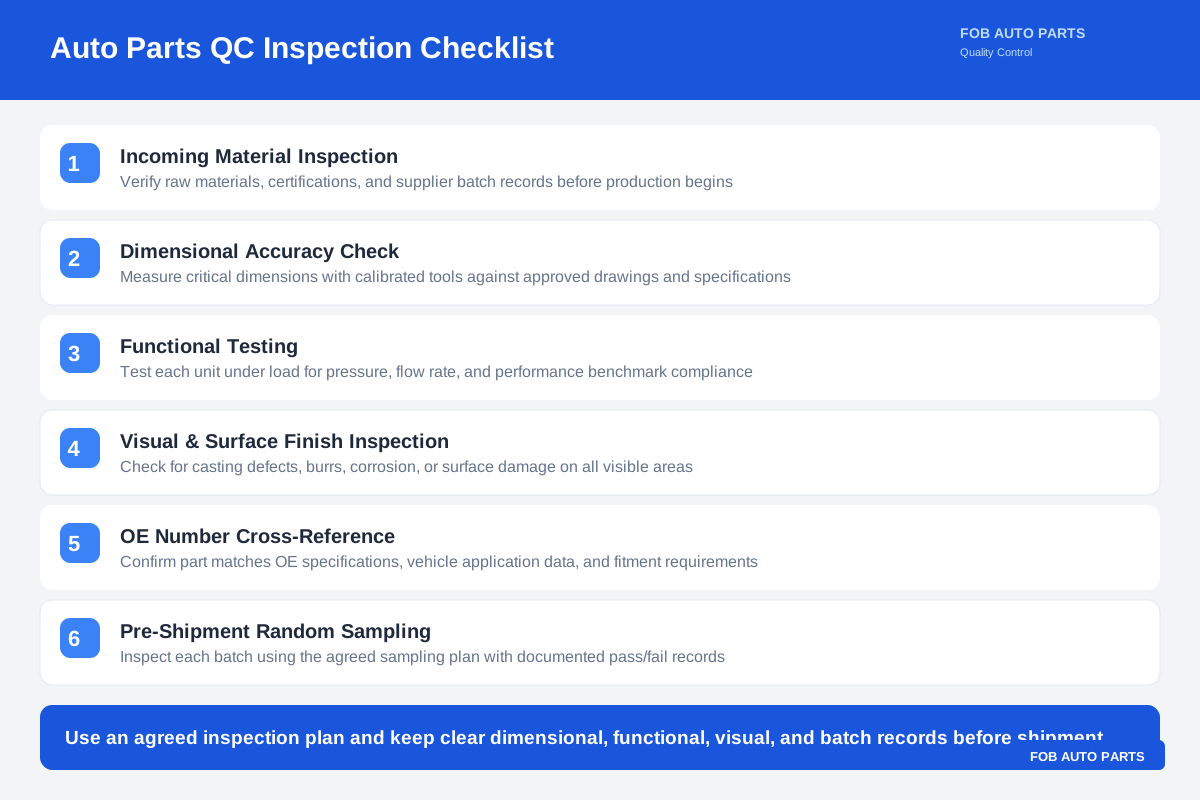
Quality failure is the biggest risk when sourcing auto parts overseas. A cheap fuel pump or brake pad that fails after installation costs far more than the unit price - it costs returns, warranty claims, and customer trust.
Ask suppliers to describe their QC process in concrete terms. A reliable supplier should explain:
- Incoming inspection: How are raw materials and sub-components verified?
- In-process checks: Are there inspection points during production?
- Final inspection: What percentage of units are tested before shipment?
- Defect policy: What is the expected defect rate, and how are defective units handled?
- Certifications: Do products hold relevant standards such as ISO/TS 16949 or CE where applicable?
Do not accept vague answers like "our quality is good." Ask for QC facility photos, inspection reports, or test data.
3. Check OE Number and Application Data Accuracy
In auto parts, data accuracy is as important as build quality. A part that looks identical but carries the wrong OE reference or incorrect fitment data will generate returns and complaints.
Test a supplier's catalog quality:
- Can they provide OE number cross-references for the parts you need?
- Do listings include accurate make, model, year, and engine data?
- How quickly and accurately do they match OE numbers from your inquiry?
- Is their catalog updated as new vehicle models are released?
A professional supplier confirms fitment before quoting. Inability to verify application data is a warning sign.
Pro tip: Send 5 to 10 OE numbers during initial inquiry and compare accuracy and speed across suppliers. This simple test reveals a great deal about data quality.
4. Assess Product Range and Category Depth
Consider your sourcing strategy: do you want a specialist excelling in one category, or a one-stop supplier covering multiple lines?
- Specialist suppliers often offer deeper expertise and better pricing in their core category.
- One-stop suppliers reduce administrative burden - fewer purchase orders, easier consolidated shipments.
For most wholesalers, working with two to four reliable suppliers across key categories strikes a practical balance. Evaluate whether a supplier's range matches your current and near-future needs.
FOB Auto Parts covers fuel pumps, engine parts, brake parts, and other commonly replaced aftermarket categories - a fit for buyers consolidating across part types.
5. Understand MOQ, Pricing, and Payment Terms
Price matters, but never make it your only criterion. A slightly higher unit price from a supplier who ships on time and stands behind their product beats the lowest quote from a supplier who cuts corners.
When comparing quotes:
- Get a clear breakdown: unit price, packaging cost, shipping terms (FOB, CIF, EXW), and any extra fees.
- Clarify MOQ: Some suppliers set MOQ per SKU; others accept mixed orders. Get this in writing.
- Payment terms: Standard terms include 30% deposit and 70% before shipment via T/T, or L/C for larger orders. Be wary of 100% upfront on first orders.
- Volume discounts: Ask about tiered pricing for larger quantities.
A transparent supplier provides a detailed written quotation without hidden charges. If pricing changes repeatedly or omits key items, treat it as a warning.
6. Review Packaging, Labeling, and Shipping Capabilities
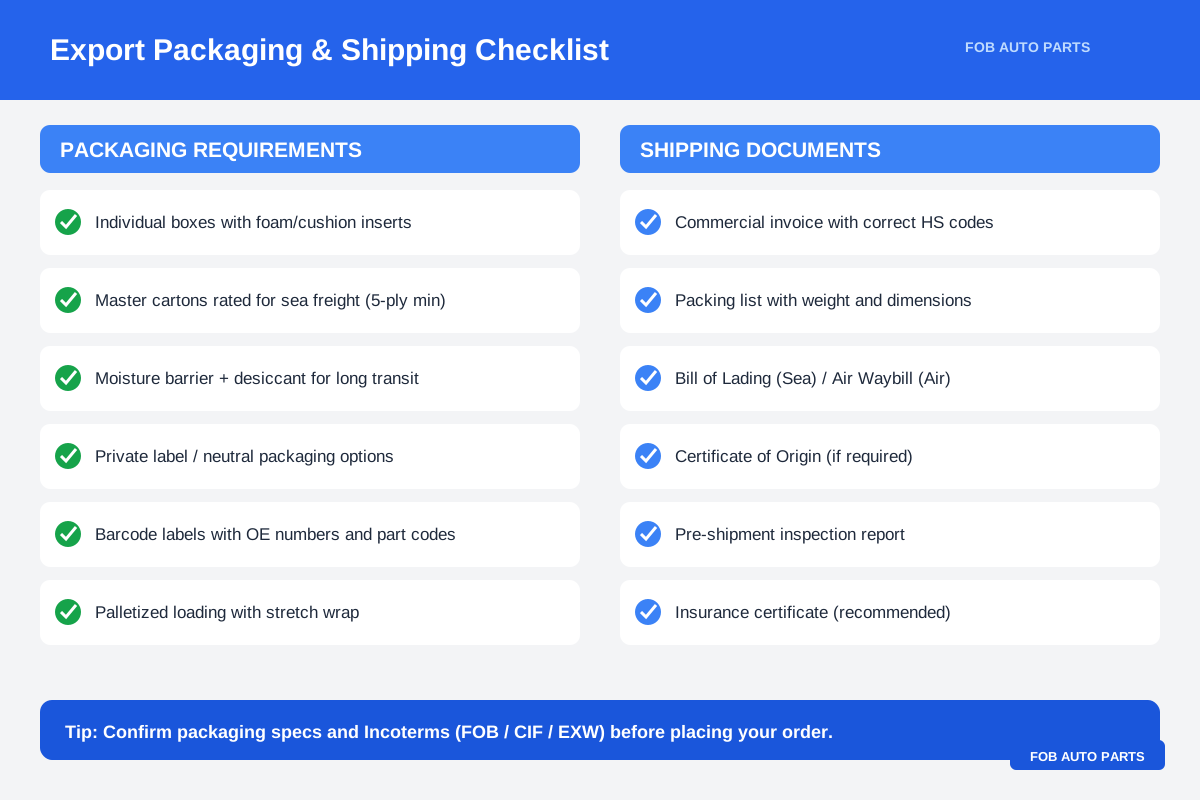
Auto parts are often heavy, fragile, or corrosion-sensitive. Poor packaging leads to damaged goods and disputes. Ask about:
- Export packaging: Individual boxes with cushioning; master cartons rated for sea or air freight.
- Labeling options: Neutral packaging, your own brand labels (private label), or branded packaging.
- Shipping methods: Sea (FCL/LCL), air, express; FOB, CIF, or DDP terms.
- Lead times and documentation: Stock versus made-to-order lead times; commercial invoice, packing list, bill of lading, certificate of origin.
Reliable suppliers have established export processes and recommend the most cost-effective shipping method for your volume and destination.
7. Test Communication and Response Quality
Communication quality matters. Over a relationship you will confirm specs, track shipments, resolve issues, and coordinate repeats. A slow or unclear communicator creates costly misunderstandings.
During initial exchanges, evaluate:
- Response time: Do they reply within 24 business hours?
- Technical knowledge: Can they answer specification and compatibility questions?
- Language clarity: Can they communicate clearly in written English? Miscommunication is a leading cause of wrong orders.
- Proactivity: Do they ask clarifying questions, or simply wait for instructions?
A supplier who asks good questions about your market, quality expectations, and packaging preferences is usually more invested in getting the order right.
8. Ask for Samples and Start with a Trial Order
No amount of research replaces physically evaluating the product. Before a large order:
- Order samples of 2 to 5 key SKUs. Inspect dimensional accuracy, material quality, finish, markings, and packaging. Compare against OE originals if available.
- Place a trial order (for example, 50 to 200 units across several SKUs) to test the full workflow: quotation, QC, packing, shipping, documentation, and after-sales.
- Inspect the trial shipment on arrival before scaling up.
A small upfront investment is far cheaper than discovering problems after a full container lands.
Quick Supplier Evaluation Checklist
Use this table as a quick reference during supplier assessment:
| Evaluation Criteria | What to Check |
|---|---|
| Business legitimacy | Business license, export history, verifiable references |
| Quality control | Documented QC process, inspection checkpoints, defect policy |
| OE / data accuracy | Can match OE numbers, provides fitment data, catalog quality |
| Product range | Covers your target categories, adequate inventory depth |
| Pricing transparency | Detailed written quotes, no hidden fees, reasonable MOQ |
| Packaging & shipping | Export-grade packaging, multiple Incoterm options, clear lead times |
| Communication | Responsive, technically competent, clear written English |
| Trial readiness | Willing to provide samples, accepts trial orders |
If a supplier fails two or more criteria, proceed with caution.
Frequently Asked Questions
How do I know if a Chinese auto parts supplier is a factory or a trading company?
Ask directly and request their business license (factories show a manufacturing scope). You can also request factory photos or a video tour. Keep in mind that a competent trading company with strong QC and established factory relationships can sometimes serve you better than a small factory with limited export experience. Focus on capability, not labels.
What is a reasonable MOQ when ordering auto parts from China?
MOQs vary by product. Stock items may have MOQs as low as 10 to 50 pieces per SKU, while custom parts can require higher volumes. Many suppliers are flexible on mixed-SKU orders once a relationship is established. Clarify MOQ during initial discussions.
How can I reduce the risk of receiving wrong or defective parts?
Confirm OE numbers and applications in writing before production. Request pre-shipment inspection reports. Start with samples and a trial order. Use secure payment methods and work with suppliers that have a clear defect policy. For larger orders, third-party inspection services such as SGS or Bureau Veritas can perform container-level checks.
How long does shipping take from China to major markets?
Sea freight takes 18 to 40 days depending on destination. West Coast USA takes approximately 18 to 25 days, East Coast USA and Europe 30 to 40 days. Air freight takes 5 to 10 days, express courier 3 to 7 days at higher cost.
Can I get private label or custom packaging from Chinese auto parts suppliers?
Yes. Many suppliers - including FOB Auto Parts - offer neutral packaging, custom labels, or branded packaging for qualified orders. Discuss requirements early, as custom packaging may carry MOQ and add lead time.
Ready to Source from a Trusted Supplier?
Choosing a reliable Chinese auto parts supplier takes due diligence - verifying credentials, evaluating quality processes, testing communication, and starting with a trial order - but the payoff is a long-term partnership that helps your business grow margins and reduce risk.
If you are sourcing replacement auto parts - fuel system components, engine parts, brake parts, or other aftermarket categories - send us your OE number list, product photos, target quantities, and destination country or port. Our team will check availability, confirm specifications, and return a detailed quotation for your review.
Send Us Your Parts List